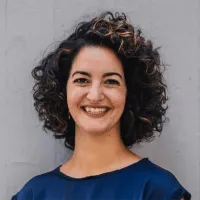
Eleni Stavrinidou is Senior Associate Professor of Bioengineering and leader of the Electronic Plants group at Linköping University.
Eleni Stavrinidou is Senior Associate Professor of Bioengineering and leader of the Electronic Plants group at Linköping University. She received a PhD in Microelectronics from EMSE (France) in 2014. She then did her postdoctoral training at Linköping University (Sweden) during which she was awarded a Marie Curie fellowship. In 2017 Stavrinidou became Assistant Professor at Linköping University and established the Electronic Plants group. In 2020 she became Associate Professor and Docent in Applied Physics. She received several grants including the Future Research Leaders grant of the Swedish Foundation for Strategic Research, ERC-Staring Grant and Swedish Research Council Consolidator Grant. Stavrinidou is recipient of the L’ORÉAL-UNESCO For Women in Science prize in Sweden (2019), the Tage Erlander Prize for Natural Sciences and Technology from the Royal Swedish Academy of Sciences (2023) and the Young Scientist Award in Natural Sciences from the Cyprus Academy of Sciences, Letters and Arts (2025). Since 2023 Stavrinidou is serving as Associate Editor of Science Advances. Her research interests focus on plant bioelectronics for real time monitoring and dynamic control of plant physiology and plant-based biohybrid living materials and devices.
Achilleas Savva
Assistant Professor, Delft University of Technology
Dr. Achilleas Savva is an Assistant Professor of Bioelectronics at Delft University of Technology (TU Delft), where he leads the Regenerative Biohybrid Electronic Technologies (ReBooT) Lab.
Dr. Achilleas Savva is an Assistant Professor of Bioelectronics at Delft University of Technology (TU Delft), where he leads the Regenerative Biohybrid Electronic Technologies (ReBooT) Lab. His research focuses on organic and soft bioelectronics, developing electrically active materials and devices to interface with, monitor, and control neural and stem-cell systems. His work spans organic mixed ionic–electronic conductors, conducting hydrogels, microelectrode arrays, and 3D bioelectronic interfaces for regenerative medicine and neuroscience. Before joining TU Delft in 2023, he was a Marie Skłodowska-Curie Fellow at the University of Cambridge and a postdoctoral researcher at KAUST. He has published more than 70 peer-reviewed articles and has received recognition including the MRS Early Career Distinguished Presenter Award and the RSC Journal of Materials Chemistry Emerging Investigators recognition.
Christina Tringides
Assistant Professor, Rice University
Christina M Tringides is a tenure-track assistant professor in Materials Science and NanoEngineering, and a core member of the Neuroengineering Initiative (NEI) at Rice, and joined July 2024.
Christina M Tringides is a tenure-track assistant professor in Materials Science and NanoEngineering, and a core member of the Neuroengineering Initiative (NEI) at Rice, and joined July 2024. She earned her B.S. degrees in physics and in materials science and engineering from the Massachusetts Institute of Technology (MIT) in 2015, and spent one year as a Fulbright Scholar and Swiss Government Excellence Scholar at the Ecole Polytechnique Federale de Lausanne before starting her PhD in 2016. Her PhD work was done in the laboratory of Professor David Mooney (Harvard, School of Engineering and Applied Sciences), and her degree came from Harvard Biophysics and the Medical Engineering Medical Physics program between Harvard and MIT in May 2022. Afterwards, Christina moved to ETH Zürich, where she was an ETH Postdoctoral Fellow, with Professor Janos Vörös (D-ITET, Institute of Biomedical Engineering). Her research focuses on developing new materials and neurotechnologies to interface with the nervous system, from the cell to organ levels, and for both in vivo and in vitro applications.