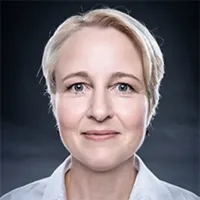
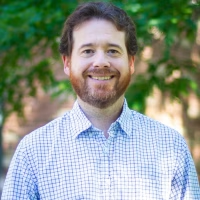
Prof. Maria Asplund is Professor in bioelectronic microtechnology at Chalmers University of Technology in Gothenburg in Sweden.
Prof. Maria Asplund is Professor in bioelectronic microtechnology at Chalmers University of Technology in Gothenburg in Sweden. Her research includes implantable flexible neurotechnology, tissue-device interaction and electronic biomaterials. Her team has specialized in electrode materials for efficient and safe charge injection over the entire parametric range used clinically, from promotion of wound healing to brain implants for visual restoration. Additionally, she develops microfluidic platforms where the interplay between electrical stimulation and tissue signaling can be studied in detail. After completing her PhD at the Royal Institute of Technology (Stockholm, 2009) she led her own research group at the University of Freiburg, Germany (2011-22) before joining Chalmers in 2022. Her work has this far resulted in new technologies which contributes to smaller, more energy efficient and durable bioelectronics for the future.
Alexander Boys
Dartmouth College
Prof. Alexander Boys is Assistant Professor of Engineering at Darmouth College in Hanover, United States of America.
Prof. Alexander Boys is Assistant Professor of Engineering at Darmouth College in Hanover, United States of America. Alexander is a materials scientist and biomedical engineer focusing on developing integrative bioelectronic implants for interacting with the body. Prior to joining Dartmouth, Boys earned a PhD in materials science and engineering at Cornell University, where he studied interfacial tissues to develop living implant systems through an NIH F31 fellowship. After this, he moved overseas to the University of Cambridge to work on tissue engineered bioelectronic implants for interfacing with the nervous system through an HFSP cross-disciplinary fellowship.
Ritchie Chen
University of California
Prof. Ritchie Chen is Assistant Professor of Neurological Surgery, Psychiatry and Behavioral
Sciences, and Bioengineering and Therapeutic Sciences.
Prof. Ritchie Chen is Assistant Professor of Neurological Surgery, Psychiatry and Behavioral
Sciences, and Bioengineering and Therapeutic Sciences. He is a materials scientist interested in creating new technologies to probe and study complex biological systems. He earned his PHD in Materials Science and Engineering at MIT, where he invented a wireless neuromodulation technology using magnetic nanotransducers. Ritchie is currently a Simons Postdoctoral Fellow at MIT’s Institute for Medical Engineering, where he is working on new chemistries that will enable imaging of molecular markers in intact organs in Dr. Kwanghun Chung’s group.
Anna Herland
KTH Royal Institute of Technology
Prof. Anna Herland is Professor in Nanobiotechnology at SciLifelab, the Department of Protein Science at KTH Royal Institute of Technology in Sweden.
Prof. Anna Herland is Professor in Nanobiotechnology at SciLifelab, the Department of Protein Science at KTH Royal Institute of Technology in Sweden.
Her research focuses on developing microphysiological systems, known as Organ-on-Chip (OoC) models, to replicate human tissue environments. By leveraging expertise in stem cell engineering, particularly with human-induced pluripotent stem cells (hiPSCs), her team creates patient-specific in vitro models that closely mimic in vivo biological functions. These models are integrated with organic bioelectronics to enable real-time functional assessments. A significant aspect of her work involves constructing advanced models of the human neurovascular unit to study neuronal interactions, metabolic functions, and neuronal activity. These models are instrumental in evaluating drug biodistribution and cell-cell interactions, aiming to improve the understanding of the blood-brain barrier and its role in health and disease. Herland’s interdisciplinary approach combines organic electronics, sensing technologies, and microfluidics to develop dynamic, nanoscale imaging techniques. Her contributions have been recognized with awards such as the Göran Gustafsson Foundation Award, and she has been named a Wallenberg Academy Fellow. Herland’s research has significant implications for drug development and personalized medicine, providing innovative platforms for studying complex biological systems.
Dion Khodagholy
University of California Irvine
Prof. Dion Khodagholy is Henry Samueli Associate Professor at the Department of Electrical Engineering and Computer Science in University of California Irvine in the United States of America.
Prof. Dion Khodagholy is Henry Samueli Associate Professor at the Department of Electrical Engineering and Computer Science in University of California Irvine in the United States of America. He received his Master’s degree from the University of Birmingham (UK). He obtained his Ph.D. in microelectronics at the Department of Bioelectronics (BEL) of the Ecole des Mines (France). His postdoctoral research at New York University, Langone Medical Center was focused on large-scale cortical acquisition and analysis. He was an associate professor at Columbia University prior to joining UCI. His research explores the interface of electronics and the brain in the context of both applied and discovery sciences, with the ultimate goal of new innovations in device engineering and neuroscience methods to improve diagnosis and treatment of neuropsychiatric disease.
Scott Keene
Rice University
Prof. Scott Keene is Assistant Professor at Rice University in Houston, United States of America.
Prof. Scott Keene is Assistant Professor at Rice University in Houston, United States of America. Scott earned his B.S. from the University of Washington in 2015. He earned his PhD in 2020 from Stanford University, where he developed neuromorphic memory devices and biosensors using conducting polymers. He then joined the Department of Electrical Engineering and Cavendish Laboratory at the University of Cambridge with a Marie Curie postdoctoral fellowship to study mixed ionic‐electronic transport in conducting polymers. In July 2024, he joined the Department of Materials Science and NanoEngineering at Rice University as an assistant professor. He is currently interested in developing conducting polymer devices to address challenges in neuroengineering.
Adrica Kyndiah
Istituto Italiano di Tecnologia
Dr. Adrica Kyndiah is Senior Researcher at Istituto Italiano di Tecnologia in Italy.
Dr. Adrica Kyndiah is Senior Researcher at Istituto Italiano di Tecnologia in Italy. She received her B.Sc and M.Sc degree in Physics from North Eastern Hill University, Shillong , India in the year 2008 and 2010 respectively. In 2011, she moved to Bologna, Italy, to pursue her doctoral studies where she was awarded the PhD degree from the Chemistry Department of the Alma Mater Studorium Università di Bologna in April 2015. While she was pursuing her PhD, she worked in the field of Organic Electronics as an integral part of Prof. Fabio Biscarini’s team, at the National Council of Research (CNR-ISMN) of Bologna. Her thesis was focused on the study of charge transport, growth phenomena and interaction at the various interfaces of an Organic Field Effect Transistor. Immediately after her PhD she worked as a postdoctoral fellow at the French Alternative Energies and Atomic Energy Commission (CEA) in Grenoble for a period of one year (from August 2015 to August 2016) where her research activity was to formulate organic materials towards stable optoelectronic components. In September 2016 she joined the IMS lab at the Centre Nationnal de la Recherche Scientifique (CNRS) in Bordeaux, France, where her main task was to set up a protocol to fabricate Hybrid Organic Light Emitting Transistor. In May 2017, she won the Marie Curie postdoctoral fellowship and joined the Nanoscale Bioelectrical Characterization group of Prof. Gabriel Gomila at the Institute of Bioengineering of Catalonia IBEC in Barcelona,Spain. At IBEC, she opened a new line of research on bioelectronics where she worked on cell recording activity and nanoscale electrical characterisation of bioelectrical devices. She joined IIT as a researcher in July 2020 where is coordinating most of the Biosensors and Bioelectronics related project within the group of Mario Caironi.
Stephanie Lacour
École Polytechnique Fédérale de Lausanne
Prof. Stéphanie P. Lacour is full Professor at the School of Engineering at the Ecole Polytechnique Fédérale de Lausanne in Switzerland.
Prof. Stéphanie P. Lacour is full Professor at the School of Engineering at the Ecole Polytechnique Fédérale de Lausanne in Switzerland. She received her PhD in Electrical Engineering from INSA de Lyon, France, and completed postdoctoral research at Princeton University (USA) and the University of Cambridge (UK). She joined EPFL in 2011. She was the founding director of EPFL Neuro X institute – a new interschool department focused on interdisciplinary and translational neuro-research located at EPFL-associated campus – Campus Biotech in Geneva. Since 2025, she is EPFL Vice-President for support to Strategic Initiatives.
Guglielmo Lanzani
Politecnico di Milano / Istituto Italiano di Tecnologia
Prof. Guglielmo Lanzani is Principal investigator at the Center for Nano Science and Technology at POLIMI Istituto Italiano di Tecnologia and Professor of Physics at Department of Physics at Politecnico di Milano in Italy.
Prof. Guglielmo Lanzani is Principal investigator at the Center for Nano Science and Technology at POLIMI Istituto Italiano di Tecnologia and Professor of Physics at Department of Physics at Politecnico di Milano in Italy. Prof. Lanzani got his Physics degree (laurea) in 1987. He was a visiting scientist at University of Utah, SLC-UT, USA, from 1989-90. He got a PHD in Chemical Physics. He started his Post Doc in 1992 and finished it in 1994, at ISM-C.N.R., Bologna. After that, he had the position of Assistant Professor from 1994-1999 at University of Sassari. From 1999-2011 he was an Associate Professor in physics at Politecnico di Milano and a coordinator of the Center for Nano Science Technology at POLIMI Istituto Italiano di Tecnologia from 12/2009 to 05/2023. Guglielmo Lanzani has a background in the photo-physics of nanostructured and molecular materials. His research activity, reported in more than 350 publications, regards applications in energy, bio-photonics, neuroscience and medicine. In particular, the overarching goal of the research is to induce light sensitivity in living cells, tissue or organism by developing new light actuators. He is involved in the project for developing an artificial retina prosthesis and in two start-up companies.
Lan Luan
Rice University
Prof. Gregory L. Whiting is Associate Professor at University of Colorado Boulder in the United States of America.
Dr. Luan was trained as an experimental physicist. Dr. Luan received her B. S. from the University of Science and Technology of China with a major in Physics and a minor in Electrical Engineering. She then went to Stanford University to pursue her Ph. D. in Physics (2011), followed by three years at Harvard University as a postdoctoral fellow in the Physics department. She moved to Austin in the fall of 2014 and decided to make the transition from Physics to Biomedical Engineering while being a research scientist in the department of Physics. She joined the Department of Biomedical Engineering as a research assistant professor in Sep 2017 and started her independent research on integrative neural interface since then. She moves to Rice University in Oct 2019 to join the faculty in department of electrical and computer engineering and as part of the Neuroengineering Initiative.
George Malliaras
University of Cambridge
Prof. Malliaras is Professor at University of Cambridge in England.
Prof. Malliaras is Professor at University of Cambridge in England. He leads a group of scientists, engineers and clinicians who study the fundamental processes at the abiotic/biotic interface and develop better tools for healthcare. Ηe is interested in the development and translation of implantable and wearable devices that interface with electrically active tissues, with applications in neurological disorders and brain cancer.
Massimo Mastrangeli
Delft University of Technology
Prof. Massimo Mastrangeli is Associate Professor at Delft University of Technology in The Netherlands.
Prof. Massimo Mastrangeli is Associate Professor at Delft University of Technology in The Netherlands. As Associate Professor at TU Delft’s ECTM section of the Microelectronics department, Massimo “Max” Mastrangeli leads the research in design and fabrication of innovative micro electro-mechanical physiological systems (MEMPhyS), and investigates processes for ultra-high throughput assembly of microcomponents. Massimo received the B.Sc. and M.Sc. degrees cum laude in Electronic Engineering from Universitá di Pisa, (Pisa, Italy) in 2003 and 2005, respectively, and the Ph.D. degree in Materials Engineering from University of Leuven (Leuven, Belgium) in 2010. His doctoral dissertation explored the integration of microsystems by fluidic and surface tension-driven self-assembly.
From 2011 to 2013 Massimo was Post-Doctoral Scientist with the Distributed Intelligent Systems and Algorithms Laboratory (DISAL) and the Microsystems Laboratory (LMIS1) of École Polytechnique Fédérale de Lausanne (EPFL, Lausanne, Switzerland), investigating the convergence of micro/nanosystems and distributed robotics into smart minimal agents.
In 2014, Massimo joined the Department of Bio, Electro And Mechanical Systems (BEAMS) of Université Libre de Bruxelles (ULB) as Senior Scientist, investigating surface tension-based micromanipulation and templated nanoparticle assembly for plasmonic applications.
As Research Associate at the Physical Intelligence Department of the Max Planck Institute for Intelligent Systems and Associated Member of the Max Planck ETH Center for Learning Systems (Stuttgart, Germany) between 2015 and 2017, Massimo focused his research on micro-robotics, bio-inspired adhesion, and programmable self-organization.
Dr. Mastrangeli joined the ECTM group at TU Delft in 2017 as Assistant Professor, to be promoted in 2023 to Associate Professor. Massimo currently holds also the following roles:
chairman of ISO’s committee on Microphysiological Systems and Organ-on-Chip (ISO TC276/SC2)(2025-);
vice-chair of hDMT’s consortium assembly (2025 -);
board member of the European Organ-on-Chip Society (EUROoCS)(2023 -);
Lecturer at the EDMI Doctoral School of École Polytechnique Fédérale de Lausanne (2014 -);
Dr. Veiseh received a dual Ph. D. in Materials Science & Engineering and Nanotechnology from the University of Washington. He completed his postdoctoral research with Prof. Robert Langer and Daniel G. Anderson at MIT and Harvard Medical School.
Iain McCulloch
Oxford/Princeton University
Prof. Iain McCulloch is Professor at Princeton University in the United States of America.
Prof. Iain McCulloch is Professor at Princeton University in the United States of America. Iain McCulloch’s research involves the design, synthesis and development of semiconducting small molecules and polymers for use as transistors for display, solar cells and most recently biological sensing. His efforts have focused on the understanding and control of microstructure and energy levels in conjugated aromatic semiconducting polymers and the subsequent impact on device properties. This has resulted in several commercial products including lithographic formulations and printable semiconducting inks. His research continues to broaden in scope, including making important contributions in organic photovoltaics, where he is exploring new electron acceptor materials, doping effects, and fundamental optical absorption phenomena. In addition, he is developing biological sensing and electrochemical devices, which have resulted in the first demonstration of solid-state optical semiconducting sensors for measurement of cations, as well as fundamental molecular design rules of semiconducting polymers for organic electrochemical transistors. Most recently, he has discovered that organic semiconducting nanoparticle blends are efficient photocatalysts for the production of hydrogen from water and the reduction of carbon dioxide.
Michael G. Monaghan
Trinity College Dublin
Prof. Michael Monaghan is Professor of Biomedical Engineering at Trinity College Dublin in Ireland.
Prof. Michael Monaghan is Professor of Biomedical Engineering at Trinity College Dublin in Ireland. His group’s primary research areas are in biomaterials (in particular electroconductive biomaterials), advanced processing and rational design of biomaterials, cardiac tissue regeneration, and real-time imaging of extracellular matrix components and metabolism in differentiation and disease. He leads a number of interdiciplinary projects between other academic groups and industry ranging from immunometabolism, evaluation of fibrosis, biomaterial synthesis and induced pluripotent stem cell derivitisation of cardiac organoids. Dr. Monaghan performed his Postdoctoral research in Germany as a recipient of a prestigious Marie Curie Individual Fellowship at the Department of Cell and Tissue Engineering in the Fraunhofer Institute for Interfacial Engineering and Biotechnology and the Department of Women’s Health in University Clinic Tubingen. During this period he has published a number of key findings in the field of human valvulogenesis, embryonic stem cell research, cardiomyocyte differentiation, biomaterials and non-invasive optical characterisation (Raman microspectroscopy, fluorescent lifetime imaging (FLIM), multiphoton and second harmonic generation (SHG) imaging). Dr. Monaghan received both his B.Eng (Biomedical) and Ph.D. (Biomedical Engineering) from the National University of Ireland Galway (NUIG). During his Ph.D. Dr. Monaghan received a number of research awards such as travel awards from the European Molecular Biology Organisation (EMBO) and the German Academic Exchange Service (DAAD), and the 2015 Julia Polak European Doctorate Award in recognition of the achievements made during his Ph.D. Dr. Monaghan is actively involved in the tissue engineering and regenerative medicine international society (TERMIS); previously as Chair of the EU Student and Young Investigator Section. He is council member of Matrix Biology Ireland and acts as treasurer of this society. Since 2023 he serves as a board member on the International BioBrillouin Society. He and his group have received notable prestigious awards including the Robert Browne Early Career Investigator Award issued by the Tissue Engineering and Regenerative Medicine International Society (TERMIS-EU Chapter, 2023) and Engineers Ireland Medal (Matteo Solazzo, 2022). Currently at TCD he is coordinating a Horizon2020 MSCA-Doctoral Network (flimagin3D-DN) worth €3.1 million and in 2023 was awarded a European Research Council (ERC) Consolidator Grant worth €2.58 million. Lab Website: www.monaghanlab.com
Dante Muratore
Delft University of Technology
Prof. Dante G. Muratore is Assistant Professor at Delft University of Technology in the Netherlands.
Prof. Dante G. Muratore is Assistant Professor at Delft University of Technology in the Netherlands. He was born in Buenos Aires, Argentina. He received a B.Sc. and an M.Sc. degree in Electrical Engineering from Politecnico of Turin, Italy in 2012 and 2013, respectively. He received a Ph.D. degree in Microelectronics from the University of Pavia, Italy in 2017 in the Integrated Microsystems Lab. From 2015 to 2016, he was a Visiting Scholar at Microsystems Technology labs at the Massachusetts Institute of Technology, USA. From 2016 to 2020, he was a Postdoctoral Fellow at Stanford University, USA. He is the recipient of the Wu Tsai Neurosciences Institute Interdisciplinary Scholar Award. Since 2020, he is an assistant professor in the Bioelectronics Section at Delft University of Technology, Netherlands, where he leads the Smart Brain Interfaces group.
His group investigates hardware and system solutions for high-bandwidth brain-machine interfaces that can interact with the nervous system at natural resolution. They contribute solutions for massively parallel bidirectional interfaces, on-chip neural signal processing, and wireless power and data transfer.
Giuseppe Paterno
Politechnico Milano
Prof. Giuseppe Paterno is Associate Professor at Politecnico di Milano in Italy.
Prof. Giuseppe Paterno is Associate Professor at Politecnico di Milano in Italy. He received a PhD in Physics at the University College London, with a project focused on the study of the structural and dynamical features of π-conjugated carbon materials by means of neutron scattering techniques. In 2015, Giuseppe obtained a Marie Curie fellowship at the CNST-IIT to investigate the optical properties of carbon-based nanomaterials via ultrafast spectroscopic techniques. Currently, he is mostly interested on the study of light-matter interactions in light-responsive molecules and photonic structures, for optoelectronics and bio-photonics. His major research achievements include: i. the photomodulation of bacterial bioelectric signalling; ii. the proof-of-concept detection of pathogenic bacteria by using hybrid plasmonic/photonic devices; iii. Τhe first report on the occurrence of optical gain in graphene quantum dots.
Viviana Rincon Montes
Forschungszentrum Jülich
Dr. Viviana Rincon Montes is PostDoc & Junior Group Leader at Forschungszentrum Jülich in Germany.
Dr. Viviana Rincon Montes is PostDoc & Junior Group Leader at Forschungszentrum Jülich in Germany. She is an electronics and biomedical engineer with a strong interest to generate translational research. To pursue this idea, Dr. Rincon Montes have focused on the development of biomedical tools, such as bioelectronic interfaces and more specifically neuroelectronic interfaces, which can facilitate the monitoring and treatment of neurological and neurodegenerative diseases. Furthermore, with the ultimate goal to understand and restore lost neuronal functions in the body, her research is oriented towards the development of neuroelectronics for in vivo applications.
Their work comprises the development of stealth neurotechnology for seamless integration with the body and bidirectional communication, which allows acknowledging and stimulating neuronal activity via electrical, optical, or chemical methods. They customize neural implants for target applications in the central (retinal and cortical) and peripheral nervous systems. To this end, we investigate new designs, materials, and implantation methods. Furthermore, they characterize and test the performance of their devices with in vitro, ex vivo, and cadaveric animal models, to achieve the end acute and chronic in vivo neural application.
Alina Rwei
Delft University of Tehcnology
Prof. Alina Rwei is Assistant Professor at Delft University of Tehcnology in the Netherlands.
Prof. Alina Rwei is Assistant Professor at Delft University of Technology in the Netherlands. Dr. Rwei engineers smart therapeutic and diagnostic platforms for next-generation precision therapies. Her long-term research goal is to bridge clinical translation with scientific discoveries by interfacing biology, materials science, and engineering in biomedical innovations that will make a long-lasting impact in patients’ lives. She aims to increase the effectiveness of drug delivery systems using chemical and materials engineering, electronic engineering and cell biology approaches. Current fields of focus include: light-, ultrasound- and magnetically-triggered therapeutics for alleviating pain and combatting cancer, wearable electronics for personalized real-time diagnostics, and study of nanoparticle and cellular interactions for designs of effective targeted delivery systems.
Francesca Santoro
Forschungszentrum Jülich
Prof. Dr. Francesca Santoro is Professor at Forschungszentrum Jülich in Germany.
Prof. Dr. Francesca Santoro is Professor at Forschungszentrum Jülich in Germany. Francesca Santoro is interested in engineering neurohybrid interfaces to bridge biology, medicine, chemistry and electrical engineering. She works on microdevices to emulate neuronal behavior and architecture. Research Topics
IBI-3-Neuroelectronics, Bioelectronics, Neuromorphics, Neuroengineering, IBI-3-Neuroelectronic Interfaces
Claudia Tortiglione
Consiglio Nazionale delle Ricerche
Dr. Claudia Tortiglione is Senior Researcher at Consiglio Nazionale delle Ricerche in Italy.
Dr. Claudia Tortiglione is Senior Researcher at Consiglio Nazionale delle Ricerche in Italy. C. Tortiglione is researcher at CNR since 2001, heading the Nanobiomolecular group at Istituto di Scienze Applicate e Sistemi Intelligenti “E.Caianiello” (ISASI-CNR, Pozzuoli) of National Research Council since 2007. After completing her graduate research at Istituto di Genetica e Biofisica (IGB-CNR, Naples), she spent two years at ICMB, University of Edinburgh, in the laboratory of Developmental Biology (Prof. M. Bownes). Back in Italy she received her PhD at University of Naples, developing new skills in Plant Genetics and Biotechnology, followed by several postdoctoral appointments. At ISASI (former Istituto di Cibernetica) she launched new research lines merging Biology to Nanoscience. Beside basic investigations on key pathways controlling development and cell differentiation using cell and molecular biology tools, the novelty of her research is the development and the use of nanoparticle-based methods for analysis of gene and cell function, manipulation of intracellular pathway, optical and magnetic hyperthermia, controlled drug delivery. Recently, she is exploiting the possibility to use organic semiconducting polymers to control cell function. She demonstrated the possibility to modulate animal behaviour and light sensitivity by using photovoltaic nanoparticles, and is currently using these materials for therapeutic purposes. More recently she exploited the possibility to use the biocatalytic machinery of living organisms for fabricating functional hybrid bioelectronic interfaces, fully integrated into the tissues, using semiconducting oligomers as build blocks
Omid Veiseh
Rice University
Prof. Omid Veiseh is Professor and CPRIT Scholar in Cancer Research in the Departments of Bioengineering and Chemical and Biomolecular Engineering at Rice University.
Prof. Omid Veiseh is Professor and CPRIT Scholar in Cancer Research in the Departments of Bioengineering and Chemical and Biomolecular Engineering at Rice University. He is also the Director of Rice University’s Biotech Launch Pad, a new initiative with a mission to accelerate the translation of Rice University’s discoveries and technologies into clinical practice to provide rapid patient access to leading-edge therapeutic products. He leads an interdisciplinary translational research program to engineer and commercialize next-generation cell-based therapeutics for various human diseases. His team leverages the latest techniques in synthetic biology, immunoengineering, and material science to develop innovative cell-based platforms for real-time and feedback-regulated production of biologics. Throughout his career, he has authored or co-authored more than 80 peer-reviewed publications, including those in Nature Biotechnology, Nature Materials, Nature Medicine, and Nature Biomedical Engineering. He is an inventor on more than 50 pending or awarded patents. He is also a serial entrepreneur who has co-founded multiple biotechnology companies, collectively attracting ~ $500M in private and public investment capital. Dr. Veiseh has been elected as a fellow of the Controlled release Society and a member of the National Academy of Inventors. Dr. Veiseh received a dual Ph. D. in Materials Science & Engineering and Nanotechnology from the University of Washington. He completed his postdoctoral research with Prof. Robert Langer and Daniel G. Anderson at MIT and Harvard Medical School
Gregory L. Whiting
University of Colorado Boulder
Prof. Gregory L. Whiting is Associate Professor at University of Colorado Boulder in the United States of America.
Prof. Gregory L. Whiting is Associate Professor at University of Colorado Boulder in the United States of America. His research is focused at the intersection of additive manufacturing, novel materials, and functional devices. He is primarily interested in using printing as a method to fabricate unconventional electronic components and systems that can be readily customized, be mechanically flexible/conformable, large area, widely distributed, biocompatible, and/or controllably transient.
Societal Impact:
Through our research we are working to develop new ways of making things that enables more distributed methods of manufacturing and provides more pervasive functionality. We are currently addressing applications in a wide range of fields including health care, agriculture, energy and space exploration.